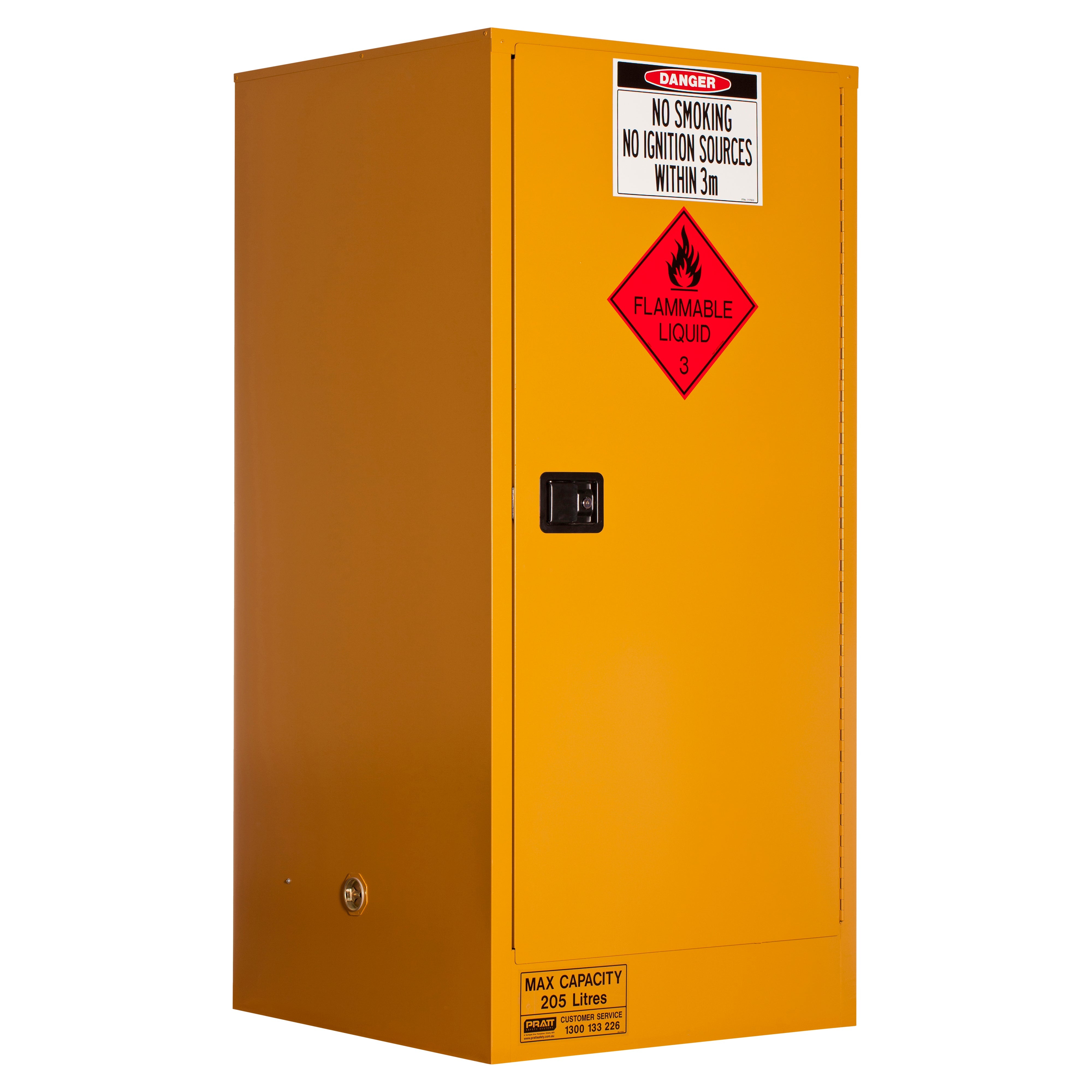
205L Pratt Flammable Liquids Storage Cabinet

SKU: DG5555VS
No reviews

Title: 205L Pratt Flammable Liquids Storage Cabinet
Price:
Sale price$3,570.00

Description

This range of cabinets is suitable for the storage of flammable or combustible liquids as classified by the United Nations criteria and the ADG Code for Dangerous Goods
  • These include flammable liquids such as Paints, Solvents, Petrol, Thinners, Kerosene, Turpentine, White Spirits, Alcohol and Ethanol. Also, combustible liquids such as Diesel, Linseed Oil and Pine Oil
  • Constructed of double walled 1.2mm thick galvanised steel
  • Single self closing door with speed adjustable hydraulic closure
  • Continual stainless steel piano type door hinge
  • Overlapping door edging to prevent ingress of heat
  • 2 x 50mm vent bungs with steel caps
  • Each vent incorporates steel flash arrester
  • 3 point self latching door mechanism
  • Recessed handle with keyed alike lock with 2 keys
  • External static earth connection and 1 x ear thing wire
  • Solvent resistant yellow baked powder coated finish
  • 150mm deep liquid tight sump
  • Palletised and packaged with strong cardboard for protection during transportation and storage
  • Flammable Liquid diamond and other decals applied
  • Shelves available to purchase for additional storage (not included)
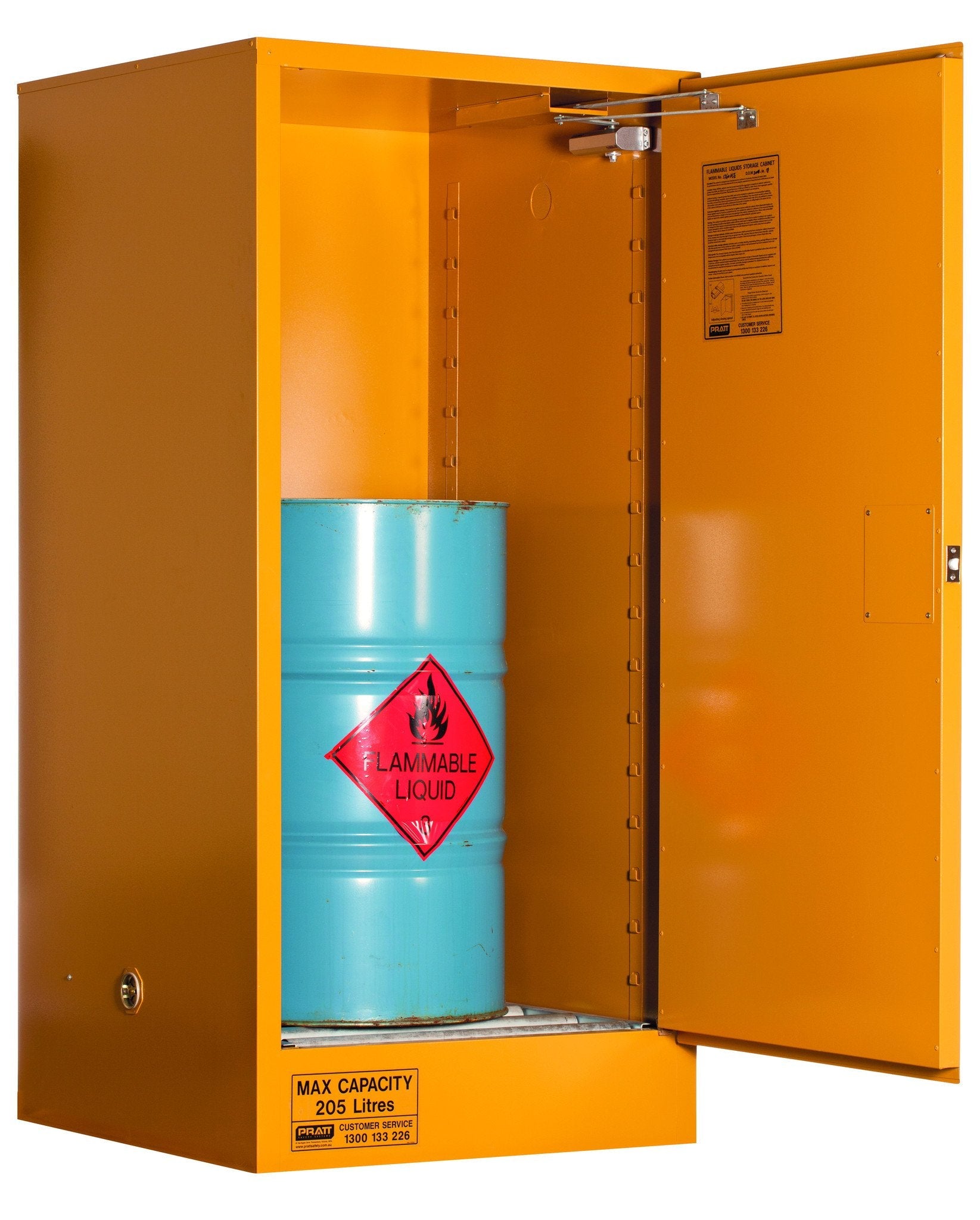
  • Vertical cabinet accommodates one 205L drum
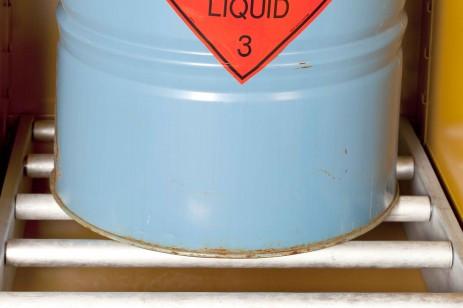
  • Fixed base roller set, to help move the drum in and out of the cabinet
 Capacity:
205L
Material of Construction:
Double Steel Walls
Doors:
1
Shelves:
Roller Set
Extra Shelf: (sold separately)
5560E-29S
External (mm):
1825(h) x 865(w) x 865(d)
Internal (mm):
1580(h) x 770(w) x 775(d)

Australian Standard Compliance

PRATT indoor flammable liquid storage cabinets comply with the Australian standard AS1940 - "The storage and handling of flammable and combustible liquids"

NOTE: This item may incur additional freight charges.  To be advised once the order has been received and reviewed.

Frequently Asked Questions

The primary Australian Standard governing the storage of flammable and combustible liquids is AS1940:2017 - The Storage and Handling of Flammable and Combustible Liquids. This is the benchmark used by WHS regulators, fire authorities, auditors, and insurers when assessing workplace compliance across Australia.

Compliance is effectively mandatory. Under the Australian Work Health and Safety (WHS) Regulations, employers who store hazardous chemicals - including flammable liquids - must ensure they are stored safely, and AS1940 is the accepted means of demonstrating that obligation is met. Many state and territory dangerous goods regulations also reference AS1940 directly.

The standard covers the full chain of storage and handling - from minor quantities stored on benchtops, through to cabinets, indoor packaged storage, and large outdoor bulk storage tanks. For most businesses, the cabinet-level provisions in Sections 2 and 4 are the most directly relevant.

All Justrite and Pratt cabinets stocked at BIG Safety comply with AS1940:2017. The Justrite range is additionally FM Approved - independently fire tested by FM Laboratories, the internationally recognised testing authority.

AS1940:2017 defines minor storage quantity limits — quantities below which reduced requirements apply and liquids may be stored on open shelves or work benches without a dedicated cabinet. Once those limits are exceeded, storage in a compliant AS1940 cabinet becomes mandatory.

Click here to read the key minor storage thresholds for Class 3 flammable liquids stored indoors.

Yes. AS1940:2017 requires that flammable liquid storage areas be appropriately placarded, and WHS Regulations also impose signage and placard obligations where hazardous chemicals are stored.

For flammable goods cabinets, the standard requirements are:

  • Flammable liquid cabinet placard: the cabinet must display the correct Class 3 Dangerous Goods diamond placard - a red diamond with a flame symbol. All Justrite and Pratt cabinets supplied by BIG Safety come with the correct AS1940-compliant placarding already fitted.
  • "FLAMMABLE - KEEP FIRE AWAY" warning label: Justrite cabinets include a reflective Haz-Alert™ warning label on the front, highly visible under fire conditions and during power outages when illuminated with a torch.
  • No Smoking / No Naked Flame signage: the area surrounding the cabinet should be clearly marked with no smoking and no ignition source signage.
  • SDS access: Safety Data Sheets for all stored substances must be readily accessible to workers and emergency responders at all times.

Justrite cabinets are supplied with AS1940-compliant placarding already in place - no additional procurement of placards is required at the time of purchase.

Both manual-close and self-closing door configurations are available in the Pratt range at BIG Safety. The correct choice depends on your regulatory environment and the level of fire risk at your site.

Justrite Self-closing doors are activated by a fusible link that melts at 74°C - at that temperature, the door mechanism releases and the door closes and latches automatically, sealing the cabinet even if workers are unable to manually close it during an emergency.

Self-closing doors are recommended when:

  • Your site handles high volumes or high-hazard flammable liquids
  • Cabinets may frequently be left open during work or in unattended storage situations
  • Your state dangerous goods regulations or insurer require self-closing doors for your storage volume

Justrite's patented concealed self-close mechanism is mounted in the roof of the cabinet - keeping the top shelf fully accessible and avoiding the door alignment issues that occur when mechanisms are door-mounted.

This is one of the most commonly misunderstood aspects of flammable cabinet design. AS1940 does not require cabinets to be actively vented in most situations - and actively venting a cabinet to atmosphere can reduce its fire resistance by creating an airflow pathway that feeds potential internal fires.

All Justrite cabinets are supplied with 2 vent bung positions — one high and the other low on opposite side panels — fitted with bungs by default. Each vent position incorporates a built-in steel flash arrester as a last line of defence against external flame propagation into the cabinet.

Venting is recommended only when:

  • Your site or building management requires mechanical extraction of vapours to keep flammable vapour concentrations below 5% of the lower explosive limit (LEL)
  • The authority having jurisdiction (fire authority, WHS regulator) specifically requires it
  • Stored liquids are highly volatile and produce vapours that exceed exposure standards even with containers sealed

If mechanical venting is connected to the cabinet, AS1940 and Justrite specifications require the use of a thermally actuated damper on the vent outlet - this automatically seals the vent when fire temperatures are reached, preserving the cabinet's fire resistance rating.

Default position: leave the vent bungs in place unless a specific regulatory or workplace requirement exists to remove them.

Flammable goods cabinets are designed to store Class 3 Dangerous Goods - flammable liquids - and combustible liquids, as classified by the UN Model Regulations, the Australian Dangerous Goods (ADG) Code, and the Globally Harmonised System (GHS).

A breakdown of Class 3 goods can be viewed here:- https://bigsafety.com.au/blogs/blog/what-liquids-can-be-stored-in-a-flammable-goods-cabinet

Always consult the Safety Data Sheet (SDS) for each substance to confirm compatibility before co-storing.

Click here to view our Dangerous Goods interactive compatability guide.

Yes - diesel and petrol are chemically compatible and can be stored together in the same AS1940-compliant flammable cabinet. Both are Class 3 flammable or combustible liquids with no reactive incompatibility between them.

Key considerations when co-storing:

  • Total volume: the combined stored volume of all liquids must not exceed the rated capacity of the cabinet
  • Container integrity: all containers must be sealed, in good condition, and appropriate for the liquid they contain
  • Labelling: each container must be clearly labelled with its contents and associated hazards
  • Large combined volumes may trigger spill response kit requirements or separation distance obligations under AS1940

What must not be co-stored with flammable liquids in the same cabinet:

  • Oxidising agents (e.g. hydrogen peroxide, nitric acid, chlorine-based products) - a critical incompatibility that can cause spontaneous ignition or violent reaction in the event of a spill or leak
  • Corrosive acids or alkalis - use a dedicated corrosive goods cabinet
  • Compressed gas cylinders - these require a gas cylinder cage

Always consult the Safety Data Sheet (SDS) for each substance to confirm compatibility before co-storing.

You can check out our Dangerous Goods interactive compatability guide here:- https://bigsafety.com.au/pages/dg-compatability-guide-v2

Aerosol cans that contain flammable propellants or flammable liquid contents can be stored in a flammable goods cabinet — and this is the recommended approach where more than minor quantities of aerosols are present on site.

The flammable content of most aerosols (typically butane, propane, or alcohol-based propellants) means they pose both a flammable vapour risk if punctured and a pressure vessel risk if exposed to heat. A double-walled, AS1940-compliant cabinet provides appropriate thermal protection.

Key points for aerosol storage:

  • Store aerosols upright to maintain valve integrity
  • Do not exceed the rated capacity of the cabinet — each aerosol's liquid volume should be included in your total stored volume calculation
  • Do not store near ignition sources or in areas exposed to direct sunlight or high ambient temperatures
  • Check the aerosol SDS — some aerosols contain additional hazards (corrosive, toxic) that may affect segregation requirements

Justrite's range also includes dedicated aerosol storage cabinets for sites where aerosols are the primary stored item. Contact BIG Safety for options if aerosol storage is your primary requirement.

Cabinet sizing should be based on your current maximum stored volume of flammable and combustible liquids, with adequate headroom for operational peaks. Additional information can be found here:- https://bigsafety.com.au/blogs/blog/what-size-flammable-cabinet-do-i-need-and-how-do-i-choose-between-30l-60l-250l-and-350l

Outdoor flammable storage cabinets — such as the Pratt range available at BIG Safety — are designed for permanent outdoor installation and are recommended when:

  • Your stored volume exceeds indoor minor storage thresholds and relocating storage outside significantly reduces the fire load within the building
  • Your facility lacks adequate indoor ventilation or has limited floor space for an indoor unit
  • AS1940 separation distance requirements for your stored volume cannot be met indoors
  • Your insurer or fire authority recommends or requires outdoor storage for quantities above a defined threshold
  • You are storing highly volatile liquids and need to minimise vapour accumulation inside the building

Pratt outdoor cabinet features include: double-wall galvanised steel construction rated for outdoor weathering; manual closing door; rubber door seal for added weather protection; two heavy duty door hinges allowing 270' opening and availability in 80L, 160L, 250L, 350L and 450L configurations.

Note: outdoor cabinets must still comply with AS1940 separation distances from buildings, property boundaries, and ignition sources. Placement of an outdoor cabinet does not automatically eliminate all separation distance obligations - check AS1940 and consult your state dangerous goods regulator.

Multiple flammable cabinets can be used at one site, but AS1940:2017 imposes specific requirements on their placement and the aggregate volumes involved.

Key rules for multiple cabinets under AS1940:

  • Minimum separation between cabinets: AS1940 requires a minimum of 300mm of clear airspace between any two flammable liquid cabinets placed in the same area
  • Aggregate volume limits: the total volume stored in all cabinets within a defined area is subject to the same indoor storage thresholds that apply to that area - simply adding more cabinets does not automatically authorise unlimited indoor storage without triggering additional controls
  • Multiple minor storage locations: AS1940 Section 2 allows multiple separate minor storage locations at the same site, provided they are physically separated and each independently complies with the minor storage requirements
  • When volumes exceed minor storage: additional controls apply, including mandatory spill response kits, mechanical ventilation systems, and potentially fire detection requirements

Always consult AS1940:2017 in full and seek advice from your state dangerous goods authority when planning storage arrangements involving multiple cabinets or large aggregate volumes.

AS1940:2017 sets specific location requirements for flammable liquid storage cabinets inside buildings:

  • Away from ignition sources: the cabinet must not be located near open flames, electrical switchboards, grinding or cutting operations, hot work areas, or any equipment that generates sparks or heat. A practical minimum clearance of at least 3 metres from any ignition source is widely applied.
  • Must not obstruct emergency egress: the cabinet must not block any emergency exit, evacuation route, or fire door - even partially
  • Upper floors: if storage is on a floor above the building's lowest level, the location must not jeopardise lower levels or impede firefighting access. A risk assessment is required for above-ground-floor locations.
  • Flammable vapour control: the location must allow vapours and spilt liquids to be contained - vapours must not be able to escape to lower levels through floor penetrations or drainage
  • Not inside stairwells, corridors, or plant rooms: these are evacuation and services pathways and are not compliant locations for flammable liquid storage

Yes — under Australian WHS legislation, employers must provide workers with the information, training, instruction, and supervision necessary for them to safely carry out their work. For workers who handle or access flammable liquid storage, this includes:

  • Understanding the flammable and explosive nature of stored liquids and their vapours
  • Correct use of the cabinet - including always keeping the door fully closed when not actively accessing stored items
  • How to read Safety Data Sheets (SDS) for stored substances and understand exposure limits and emergency procedures
  • Safe decanting and dispensing procedures - including earthing or bonding when transferring 20L or more to prevent static ignition
  • What to do in the event of a spill or leak - including use of the on-site spill response kit (mandatory for Class 3 liquid sites under AS1940:2017)
  • Location of the nearest fire extinguisher - CO₂ or dry powder are recommended for flammable liquid fires

A flammable cabinet that is not maintained correctly can fail to perform its primary function under fire conditions. AS1940:2017 and Justrite manufacturer guidance recommend the following maintenance routine:

Daily:

  • Ensure the cabinet door is fully closed and latched after each use
  • Confirm no containers are leaking - any liquid in the sump indicates a container leak requiring immediate action

Weekly:

  • Check the sump - remove and properly dispose of any accumulated liquid and clean with appropriate materials
  • Verify the self-close mechanism (if fitted) operates correctly - the door should close and latch fully without manual assistance
  • Confirm vent bungs are in place and flame arresters are clear of debris

Monthly / Quarterly:

  • Inspect the cabinet shell for corrosion, dents, or damage - pay attention to door seals and hinge integrity
  • Check the earthing connection - confirm the earth wire is secure and the connection point is clean
  • Verify placarding and warning labels remain legible and undamaged
  • Review the inventory of stored liquids against the cabinet's rated capacity

Annual:

  • Conduct a full formal inspection with a documented maintenance record
  • Replace the fusible link in the self-close mechanism if it has been exposed to heat or is corroded

All Justrite cabinets carry a 10-year limited warranty covering manufacturing defects in materials and workmanship. Spare shelves are available separately from BIG Safety for all Justrite cabinet sizes.

You may also like

Recently viewed