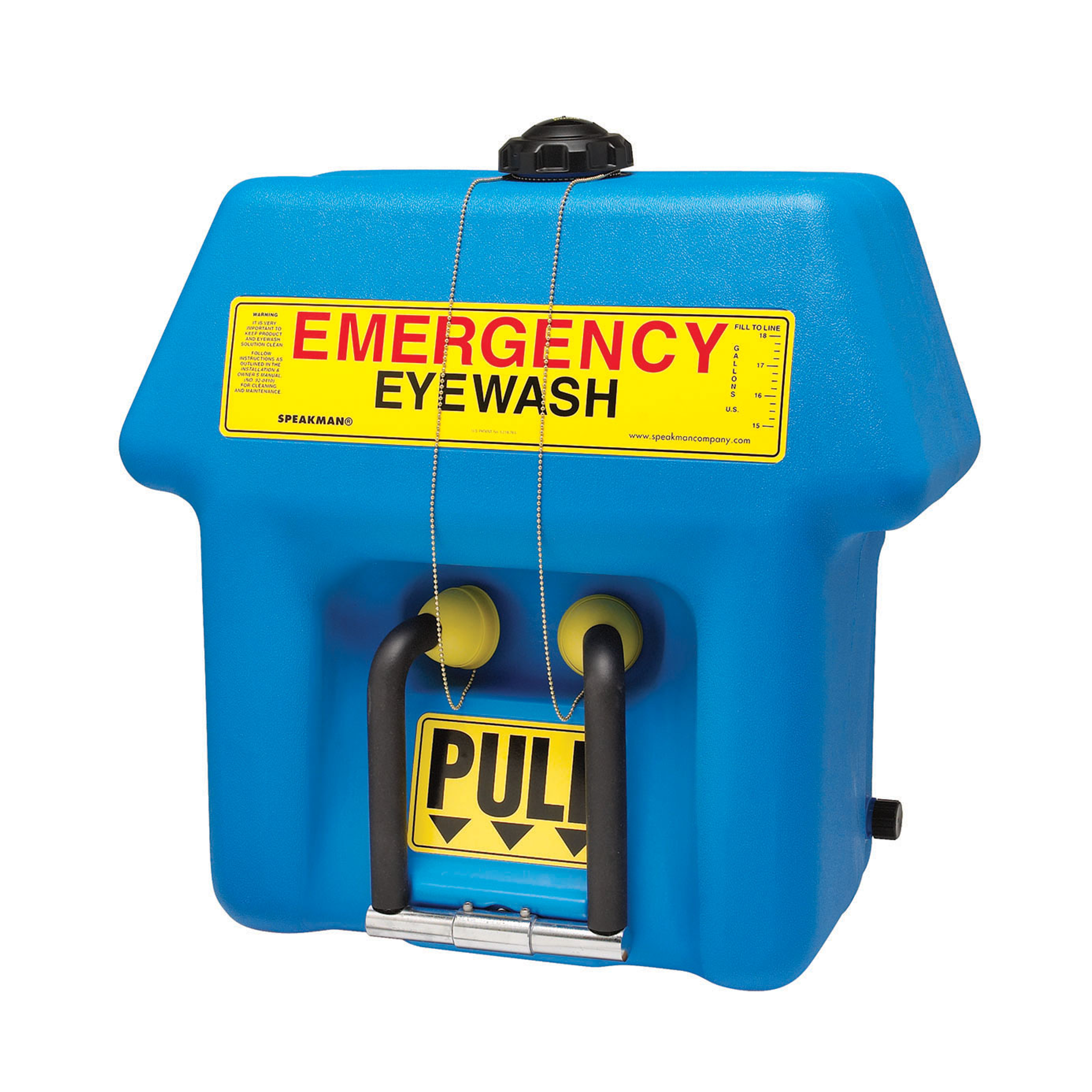
79 Litre Portable Gravityflo Eye/Face Wash Unit

SKU: DGSE4000
No reviews

Price:
Sale price$1,236.40

Description

GRAVITYFLO Gravity Fed Portable Eye/Face Wash Unit.

79 litre gravity fed eye and face wash.

Suitable for jobs that are on the go.

*NOTE: This item may require additional freight charges

The Speakman GravityFlo SE4000 Portable Safety Eye wash is designed to provide the ultimate solution to locations in need of an eyewash that have no access to a potable water source.

The GravityFlo portable eyewash station features a 79 litre tank, providing continuous flow for the ANSI/ISEA Z358.1 required 15 minutes. The SE4000 portable safety eyewash has the capability to be cart or wall-mounted, and can be placed practically anywhere within a worksite.

It is easy to relocate and setup on each new site. Activated by pull down spray arms the SE-4000 instantly delivers relieving streams, allowing hands free operation. The SE-4000 also features a side port for connection of an optional drench hose. Anti-microbial solution can also be added to the water, which means the water will last 4 months before it will need changing. Please enjoy the video below that shows how easy the SE4000 Portable Safety eye wash is to use, its features and uses.

Please note that this video is from Speakman USA. The accessories shown in the video DO NOT come as standard items when the unit is purchased, however they can be purchased seperately. The product codes are below. SE4200 - Fluid Level Gauge Cap for Gravityflo. The tamper evident ties are only available from Speakman USA. The SETAG Test Tag is a similar tag which other customers have used for the SE4000. SE TAG - Weekly Test Tag, Waterproof, 52 Week (10 pack). Please reach out to Customer service if you require pricing on any of these items.

Click here to view the Installation, Operations and Maintenance Instructions for the SE4000 Emergency Eyewash


Frequently Asked Questions

All emergency eyewash and shower equipment in Australia must comply with AS4775-2007 — Emergency Eyewash and Shower Equipment. This is the Australian equivalent of the international ANSI/ISEA Z358.1 standard. For Australian businesses that work with hazardous chemicals, using AS4775-compliant equipment is mandatory. The standard sets minimum performance requirements for flow rate, flush duration, water temperature, placement, activation method, and ongoing maintenance. All eyewash stations stocked by BIG Safety comply with AS4775-2007.
Under AS4775-2007, minimum flow rate and duration requirements vary by equipment type: - Plumbed and self-contained eyewash stations: minimum 1.5 L/min for 15 continuous minutes - Eye and face wash stations: minimum 11.4 L/min for 15 continuous minutes - Emergency safety showers: minimum 75.5 L/min for 15 continuous minutes - Drench hoses (supplemental equipment): flow must be non-injurious to the user — no fixed minimum The 15-minute minimum flush duration applies across all primary equipment types. Flushing fluid must be delivered to both eyes simultaneously at a velocity low enough to avoid injury to delicate eye tissue.
Under AS4775, eyewash stations must be: - Located no more than 10 seconds' travel time from the identified hazard - typically within 15 metres - On the same level as the hazard, with no steps or level changes between the hazard and the unit - Accessible via a clear, unobstructed path that an injured worker can navigate without full vision - Clearly identifiable with AS4775-compliant signage, and ideally marked with a green indicator light - In a well-illuminated area so the station is visible in all operating conditions All workers and visitors must be trained on the location of the nearest station and how to activate it quickly.
Yes - water temperature is a critical compliance and safety factor. AS4775 requires eyewash stations to deliver tepid water, generally defined as comfortable for extended flushing and below 38°C. Extremes of hot or cold water can cause additional injury, deter a worker from flushing for the full 15 minutes, or cause shock. For outdoor installations or sites where pipework or tanks are exposed to direct sun, a scald protection (thermostatic mixing) valve is strongly recommended to prevent scalding. For cold-climate sites, insulated or heated units are available. Tepid water compliance should be factored into every site risk assessment when selecting and installing eyewash equipment.
There are five main types of eyewash station, each suited to different workplace environments: Plumbed eyewash stations (wall, pedestal, bench, or over-sink mounted) — permanently connected to a building's water supply. Best for facilities with a fixed hazard location and reliable plumbing infrastructure. Portable self-contained units (45L, 106L) — pressurised stainless steel tanks filled with potable water. Best for remote sites, construction, mining, and agriculture where no plumbing is available. Combination eyewash and safety shower units — provide simultaneous eye, face, and full-body decontamination from a single station. Recommended wherever whole-body chemical exposure is a risk. Eye and face wash stations — deliver higher flow (11.4+ L/min) to flush both eyes and the full face, including cheeks and forehead. Suited to environments with airborne chemical, dust, or mist hazards. Personal and supplemental eyewash bottles — small first-flush units kept at the point of exposure. These do not replace primary stations; they provide immediate flushing while the worker moves to a full eyewash station. Product selection should always be based on a documented risk assessment that considers hazard type, the body areas at risk, number of workers exposed, and site plumbing availability. You can use the Big Safety Safety Shower and Eyewash Decision Flow Chart  to assist in determining the correct equipment for your needs.
Portable self-contained eyewash stations are essential wherever a fixed plumbed water supply is unavailable or impractical. Common applications in Australia include: Mining and resources - remote and fly-in-fly-out sites with no plumbing infrastructure Construction and civil works - temporary site setups, formwork, concrete, and demolition environments Agriculture - handling of pesticides, herbicides, and fertilisers in the field Emergency services, Military and hazmat response - fire crews, SES, and chemical spill response teams Transport of dangerous goods - commercial vehicles and drivers carrying classified hazardous substances Laboratories and research facilities - as supplemental first-flush equipment alongside permanent plumbed units Outdoor events and temporary facilities - any situation requiring mobile safety compliance
In most circumstances, no - but there is an important distinction. Under AS4775, portable self-contained eyewash stations are classified either as primary self-contained equipment or as supplemental equipment, depending on their capacity and compliance with flow rate requirements. Self-contained units such as the SE590A 45L and 106L, which can deliver 1.5 L/min for a continuous 15-minute flush, may serve as primary eyewash equipment on sites where no plumbing is available - provided a risk assessment confirms they are suitable for the specific hazard. Smaller personal eyewash bottles and hand-held units are classified as supplemental equipment only. They provide immediate first-flush support but must be followed by a full 15-minute flush at a primary plumbed or self-contained station. Where plumbing is available, a plumbed station is always the preferred primary solution. Portable units in that context serve as backup or supplemental equipment. A documented risk assessment is required to determine the correct classification for any given site.
The right capacity depends on your flush duration needs and whether the unit will provide both eyewash and body wash simultaneously. The SE590A 45L delivers the eyewash component at 1.5 L/min for 15 minutes, using approximately 22.5 litres for eye flushing alone. The remaining volume supports the drench hose for body washing. This unit suits smaller teams and single-person use at sites with lower overall chemical exposure risk. The SE590A 106L delivers the eyewash component at 2.3 L/min for 15 minutes and provides substantially more volume for simultaneous body washing via the drench hose. It is better suited to sites with higher chemical exposure risk, larger teams, or environments where both eye and body decontamination may be required at the same time. As a general rule, a larger capacity unit provides a greater safety margin and reduces the risk of the unit running dry during an active emergency flush.
AS4775 specifies the following inspection and activation requirements: Plumbed eyewash stations: must be activated weekly to flush stagnant water from the supply line, confirm correct function, and verify adequate flow. Weekly activation also prevents bacterial buildup - including Legionella - in standing water. Self-contained portable units: flushing fluid should be replaced every 1–2 weeks to maintain water quality and minimise contamination risk. All units: a formal inspection and maintenance record should be kept on site. Key items to check include the pressure gauge reading, nozzle condition, dust caps, hose integrity, fittings, and instruction label. Regular inspection is not merely a compliance requirement - it is the difference between a station that functions correctly during an emergency and one that fails at the critical moment.
The minimum flush time required is 15 minutes of continuous flushing at a primary eyewash station, as specified by AS4775. This duration is based on medical evidence that many chemical injuries continue to progress during the initial minutes after exposure, and that adequate, uninterrupted flushing is necessary to dilute and mechanically remove the contaminant from eye tissue. The correct emergency response sequence is: Activate the nearest eyewash station within 10 seconds of the exposure event Hold eyelids open and allow water to flush both eyes simultaneously Continue flushing for the full 15 minutes without stopping - even if discomfort appears to decrease Seek immediate medical attention after flushing is complete, regardless of the apparent severity of the injury For workers using a personal eyewash bottle as first-flush, the bottle should be activated immediately at the point of exposure, and then the worker must proceed to a primary plumbed or self-contained eyewash station for the complete 15-minute flush.

You may also like

Recently viewed