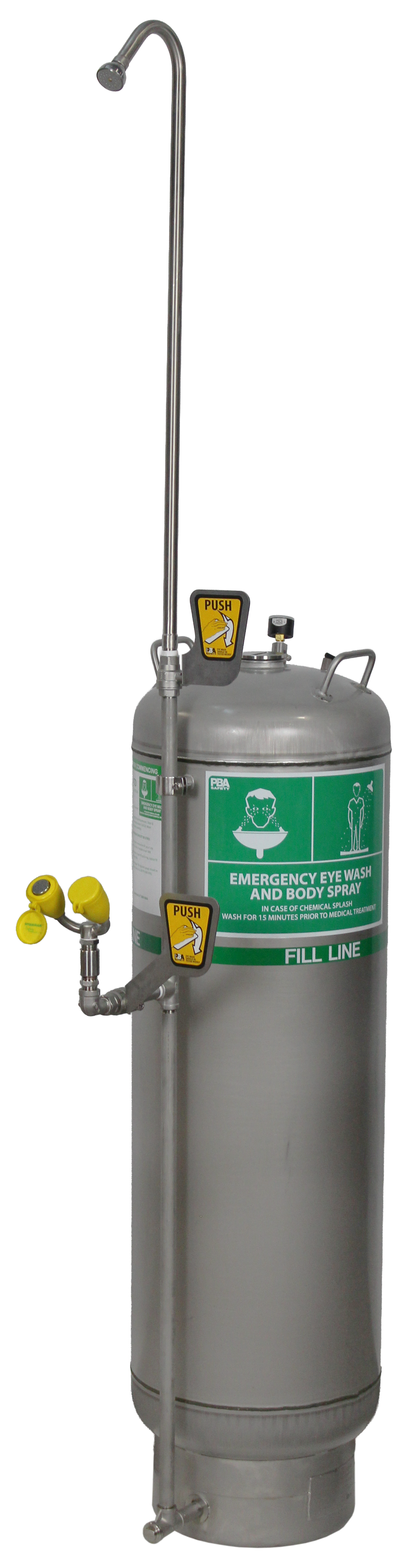
106 Litre Portable Eye Wash and Body Spray - Pre2026

SKU: DGSE590A-106-675-Pre
No reviews

Price:
Sale price$3,946.80

Description

No matter how careful you are, accidents happen. Unfortunately, when working with dangerous substances, a single drop making contact with the skin is enough to cause irreparable damage if not handled quickly. Having an emergency washing station like the SE590A-106-675 is a must for those working with hazardous substances.

This portable emergency eyewash and body spray station delivers rapid response capability for workplace incidents. Compliant with AS4775-2007 eyewash standards, it provides 106 litres of water for immediate decontamination of eyes and skin. Ideal for remote sites, construction zones, and facilities where fixed stations aren't practical, this unit ensures your team has access to critical first aid equipment when seconds count. 

Features

The SE590A-106-675 offers an array of features to help workers in the first few seconds after accidental exposure to harmful substances:

Click here to view the Features and Benefits of the new model of the SE590A-106-675

Click here to view the installation and maintenance instructions for this unit.

Sustained Operation

In accordance with AS4775 section 7.1, the eye wash component will operate for 15 minutes at 2.3 litres per minute. Providing adequate flushing without harming the delicate tissue in and around the eye.

Air Pressurised Flow

Equipped with stainless steel tanks, a pressure gauge, and an air filler, the SE590A-106-675 provides air pressurised flow for immediate flushing in situations where every second counts.

Compliant With Australian Standards

This unit is fully compliant with AS4775 regarding emergency eye wash units and body spray equipment.

However, appropriate risk assessment will determine the selection process based on the following sections of AS4775:

  • Section 7.1:Performance of plumbed and self-contained eye wash units

A means shall be provided to ensure that a controlled flow of flushing fluid is provided to both eyes simultaneously at a velocity low enough to be non-injurious to the user.

When activated plumbed and self-contained eye wash equipment shall deliver flushing fluid to the eyes at a flow rate not less than 1.5 L/min for a minimum of 15 minutes.

  • Section 11.1: General

The supplemental equipment listed below shall provide immediate flushing to support plumbed and self-contained equipment but shall not replace them.

  • Section 11.2.1: Performance of personal units

Personal wash units shall have the capacity to deliver immediate flushing without being injurious to the user. See Paragraph F6. Personal wash units do not meet the criteria of plumbed or self-contained eyewash. See Paragraph F1 Instructions and flushing fluid expiration date shall be permanently affixed to the unit.

  • Appendix F1: Personal Eyewash Units

The first seconds following an eye injury are often critical to keeping eye injury to a minimum. A personal eye wash may be kept in the immediate vicinity of employees working in a potentially hazardous area. The main purpose of these units is to supply immediate flushing. With this accomplished, the injured individual should then proceed to a plumbed or self-contained eye wash and flush the eyes for the required 15 minutes.

Click here to view the Installation, Operations and Maintenance Instructions for the SE590A-106-675 Portable Eye and Body Wash

Click here to view the Assembly Instructions for the SE590A-106-675 Portable Eye and Body Wash

*This item may require additional freight charges (to be confirmed after your order has been received)

Hand Trolley NOT included in this sales price. Hand trolley sold separately.

Frequently Asked Questions

Yes - this unit exceeds Australian Standards AS4775-2007 for Emergency Eyewashes

  1. Fill unit half way and add SE 4210 water preservative (if desired) and then fill to water line with CLEAN POTABLE WATER.
  2. Pressurise the tank to 690 KPa with clean air. Check for leaks.
  3. The unit has a Schroeder valve, same as a car tyre tube valve.
  4. The unit needs to be inflated to 690 kPa. A clean filter air compressor will work or there are some battery inflators on the market Milwaukee.etc, They take a bit longer but will eventually get it up to pressure.


Note:- Anti Microbial Water Preservative is not essential,
however it maintains water quality for up to 120 days. After 120 days the water
needs to be completely replaced. If water preservative is not used, then the
water must be fully replaced approximately every 2 weeks.

The water in a portable eyewash unit needs to be replaced every two weeks (approximately) to ensure there are no growths in the water. Antimicrobial Water Preservative can be used to prolong the life of the water for up to 120 days. https://bigsafety.com.au/products/anti-microbial-solution

This is not a Safety Shower as it does not provide 76LPM of water to spray the body for 15 minutes. The Shower head/body wash/drench hose is referred to as supplementary equipment to be used in a first response emergency treatment at the site.

You do not have to order the Trolley/Hand Truck, however customers have found it makes life easy to reposition the unit around site, to have it close to where it is needed.

These units are generally shipped in 3-5 business days, as they are assembled, quality inspected and pressure tested before shipping

Yes we provide simple assembly instruction you can follow to set this up on site

We mainly use TNT & Border Express dependant on the delivery location throughout Australia.

All emergency eyewash and shower equipment in Australia must comply with
AS4775-2007 — Emergency Eyewash and Shower Equipment. This is the Australian
equivalent of the international ANSI/ISEA Z358.1 standard. For Australian
businesses that work with hazardous chemicals, using AS4775-compliant equipment
is mandatory. The standard sets minimum performance requirements for flow rate,
flush duration, water temperature, placement, activation method, and ongoing
maintenance. All eyewash stations stocked by BIG Safety comply with
AS4775-2007.


Under AS4775-2007, minimum flow rate and duration requirements vary by equipment
type:

- Plumbed and self-contained eyewash stations: minimum 1.5 L/min for 15
continuous minutes

- Eye and face wash stations: minimum 11.4 L/min for 15 continuous minutes

- Emergency safety showers: minimum 75.5 L/min for 15 continuous minutes

- Drench hoses (supplemental equipment): flow must be non-injurious to the user
— no fixed minimum

The 15-minute minimum flush duration applies across all primary equipment types. Flushing fluid must be delivered to both eyes simultaneously at a velocity low enough to avoid injury to delicate eye tissue.

Under AS4775, eyewash stations must be:

- Located no more than 10 seconds' travel time from the identified hazard - typically within 15 metres

- On the same level as the hazard, with no steps or level changes between the hazard and the unit

- Accessible via a clear, unobstructed path that an injured worker can navigate without full vision

- Clearly identifiable with AS4775-compliant signage, and ideally marked with a green indicator light

- In a well-illuminated area so the station is visible in all operating conditions

All workers and visitors must be trained on the location of the nearest station and how to activate it quickly.

Yes - water temperature is a critical compliance and safety factor. AS4775 requires eyewash stations to deliver tepid water, generally defined as comfortable for extended flushing and below 38°C. Extremes of hot or cold water can cause additional injury, deter a worker from flushing for the full 15 minutes, or cause shock.

For outdoor installations or sites where pipework or tanks are exposed to direct sun, a scald protection (thermostatic mixing) valve is strongly recommended to prevent scalding. For cold-climate sites, insulated or heated units are available. Tepid water compliance should be factored into every site risk assessment when selecting and installing eyewash equipment.

In most circumstances, no - but there is an important distinction. Under AS4775, portable self-contained eyewash stations are classified either as primary self-contained equipment or as supplemental equipment, depending on their capacity and compliance with flow rate requirements.

Self-contained units such as the SE590A 45L and 106L, which can deliver 1.5 L/min for a continuous 15-minute flush, may serve as primary eyewash equipment on sites where no plumbing is available - provided a risk assessment confirms they are suitable for the specific hazard.

Smaller personal eyewash bottles and hand-held units are classified as supplemental equipment only. They provide immediate first-flush support but must be followed by a full 15-minute flush at a primary plumbed or self-contained station.

Where plumbing is available, a plumbed station is always the preferred primary solution. Portable units in that context serve as backup or supplemental equipment. A documented risk assessment is required to determine the correct classification for any given site.

The right capacity depends on your flush duration needs and whether the unit will provide both eyewash and body wash simultaneously.

The SE590A 45L delivers the eyewash component at 1.5 L/min for 15 minutes, using approximately 22.5 litres for eye flushing alone. The remaining volume supports the drench hose for body washing. This unit suits smaller teams and single-person use at sites with lower overall chemical exposure risk.

The SE590A 106L delivers the eyewash component at 2.3 L/min for 15 minutes and provides substantially more volume for simultaneous body washing via the drench hose. It is better suited to sites with higher chemical exposure risk, larger teams, or environments where both eye and body decontamination may be required at the same time.

As a general rule, a larger capacity unit provides a greater safety margin and reduces the risk of the unit running dry during an active emergency flush.

Portable self-contained eyewash stations are essential wherever a fixed plumbed water supply is unavailable or impractical. Common applications in Australia include:

  • Mining and resources - remote and fly-in-fly-out sites with no plumbing infrastructure
  • Construction and civil works - temporary site setups, formwork, concrete, and demolition environments
  • Agriculture - handling of pesticides, herbicides, and fertilisers in the field
  • Emergency services, Military and hazmat response - fire crews, SES, and chemical spill response teams
  • Transport of dangerous goods - commercial vehicles and drivers carrying classified hazardous substances
  • Laboratories and research facilities - as supplemental first-flush equipment alongside permanent plumbed units
  • Outdoor events and temporary facilities - any situation requiring mobile safety compliance

You may also like

Recently viewed