Great response time, easy to order what i needed and quick to deliver what i needed
Arrived on time p2 do great job..
Call Us on 1300 73 22 74 - Australian Owned & Operated
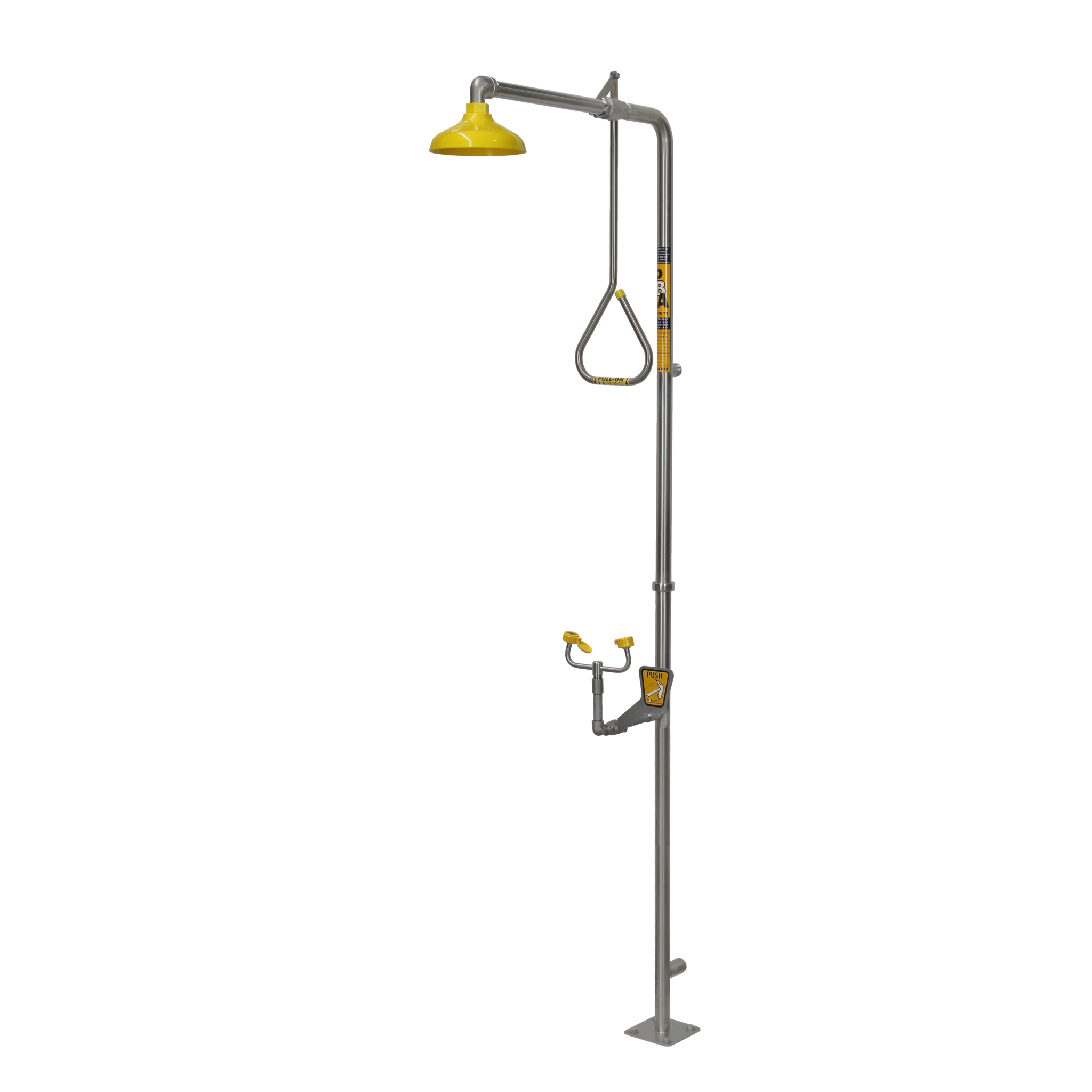
Speakman Combination Safety Shower & Aerated Eye Wash unit which is hand operated and without a bowl for quick easy access
Manufactured to comply with AS 4775-2007
Emergency safety showers in Australia must comply with AS4775-2007 — Emergency Eyewash and Shower Equipment. This is Australia's equivalent of the international ANSI/ISEA Z358.1 standard. For any Australian business where workers may be exposed to hazardous or corrosive chemicals, compliance is mandatory under WHS legislation.
AS4775-2007 sets minimum requirements for:
All safety showers in BIG Safety's range - including the full Speakman series - are manufactured and tested to comply with AS4775-2007.
The minimum flush time required is 15 minutes of continuous flushing at a primary eyewash station, as specified by AS4775. This duration is based on medical evidence that many chemical injuries continue to progress during the initial minutes after exposure, and that adequate, uninterrupted flushing is necessary to dilute and mechanically remove the contaminant from eye tissue.
The correct emergency response sequence is:
For workers using a personal eyewash bottle as first-flush, the bottle should be activated immediately at the point of exposure, and then the worker must proceed to a primary plumbed or self-contained eyewash station for the complete 15-minute flush.
An aerated eyewash mixes air into the water stream before it exits the nozzle, producing a soft, bubbling flow rather than a hard direct jet of water. This delivers two important safety advantages:
First, the aerated stream creates a gentle scrubbing action that dislodges and flushes contaminants from the sensitive mucous membranes of the eye more effectively than a flat water stream.
Second, the softer, lower-impact flow reduces the risk of additional trauma to an already irritated or chemically burned eye. This also encourages the injured worker to keep their eyes open and maintain flushing for the full 15 minutes - a critical factor in limiting long-term injury.
All Speakman eyewash stations at BIG Safety feature aerated dual-stream nozzles that deliver a minimum of 12 litres per minute in a spray pattern shaped to closely follow the natural contour of the eye socket.
A combination eyewash and safety shower is the recommended choice whenever a worker could sustain both eye and whole-body chemical exposure simultaneously - such as in chemical manufacturing, industrial processing, or laboratory environments where large volumes of corrosive or hazardous liquids are handled.
Combination units allow a single injured worker to flush their eyes and drench their body at the same time, without needing to move between two separate stations. This is especially important when a worker is in pain or disoriented. Under AS4775, when a combination unit is installed, both the shower and eyewash elements must be capable of simultaneous operation without causing a reduction in flow rate or pressure in either component.
Standalone eyewash stations are appropriate where the hazard is limited to the face and eye area only - for example, bench-level chemical handling in a laboratory or light dust exposure in a workshop.
An eyewash station delivers flushing fluid specifically to the eye area — two nozzles positioned to flush both eyes simultaneously. It does not provide coverage across the full face.
An eye and face wash station includes additional side jets or nozzles that extend flushing coverage to the cheeks, forehead, and surrounding facial tissue. It must deliver a significantly higher minimum flow rate - 11.4 L/min versus 1.5 L/min for eyewash only - to cover the larger surface area adequately.
Choose an eye and face wash station when workers face airborne hazards such as chemical mist, fumes, fine dust, or splash risks that could contact the entire face rather than just the eyes. BIG Safety stocks Speakman's SE480 (pedestal) and SE400 (wall mounted) eye/face wash models for these higher-risk applications.
There are five main types of eyewash station, each suited to different workplace environments:
Product selection should always be based on a documented risk assessment that considers hazard type, the body areas at risk, number of workers exposed, and site plumbing availability.
You can use the Big Safety Safety Shower and Eyewash Decision Flow Chart to assist in determining the correct equipment for your needs.
Yes - water temperature is a critical compliance and safety factor. AS4775 requires eyewash stations to deliver tepid water, generally defined as comfortable for extended flushing and below 38°C. Extremes of hot or cold water can cause additional injury, deter a worker from flushing for the full 15 minutes, or cause shock.
For outdoor installations or sites where pipework or tanks are exposed to direct sun, a scald protection (thermostatic mixing) valve is strongly recommended to prevent scalding. For cold-climate sites, insulated or heated units are available. Tepid water compliance should be factored into every site risk assessment when selecting and installing eyewash equipment.
There are five main types of Safety Showers and eyewash stations, each suited to different workplace environments:
Product selection should always be based on a documented risk assessment that considers hazard type, the body areas at risk, number of workers exposed, and site plumbing availability.
You can use the Big Safety Safety Shower and Eyewash Decision Flow Chart to assist in determining the correct equipment for your needs.
Correct use of a safety shower in the first moments after exposure is critical to minimising injury severity. Workers should be trained to follow this sequence:
Regular first aid training and emergency drills significantly improve response speed and compliance when an actual exposure event occurs.
AS4775 requires that plumbed safety showers be activated and tested weekly. The purpose of weekly activation is to:
In addition to weekly activation, a formal annual inspection by a suitably qualified technician is required. This should cover plumbing connections, valve integrity, thermostatic mixing valve calibration (if fitted), and overall compliance with installation requirements including shower head height and spray pattern.
Inspection records must be maintained on site. In the event of a workplace incident, documented maintenance history is critical evidence for WHS compliance and workers compensation purposes.
A safety shower that cannot be quickly returned to service after use or maintenance failure represents an ongoing compliance gap and a real safety risk. BIG Safety recommends maintaining an on-site inventory of common Speakman spare parts, including:
BIG Safety stocks the full range of Speakman accessories and spare parts. Maintaining critical spares on-site eliminates extended periods of non-compliance while waiting for parts to be shipped.
Yes. AS4775 requires that safety showers and eyewash stations be clearly identifiable in all operating conditions. Compliant signage serves two functions: it helps an uninjured co-worker quickly locate the unit to assist a casualty, and it helps an injured worker with impaired vision navigate to the station as quickly as possible.
Requirements and best practice include:
BIG Safety stocks the full range of AS4775-compliant emergency shower and eyewash signs in poly and metal format to suit all installation types.
AS4775 sets the following mandatory placement requirements for emergency safety showers:
Special case - strong acids and caustics: for workplaces handling concentrated acids or caustic substances, AS4775 recommends the eye/face wash component be positioned immediately adjacent to the hazard, not merely within 10 seconds of travel.
Most Speakman safety showers at BIG Safety are hand and foot operated — they include both a triangle pull rod for hand activation and a foot pedal for activation of the eyewash, giving the injured worker maximum flexibility regardless of the nature or location of their exposure.
Hand activation (pull rod) is the standard method. The worker pulls the triangle handle downward to open the stay-open full-flow ball valve — the shower then runs continuously without the worker needing to hold anything.
Foot activation is critical when a worker's hands are contaminated with hazardous substances — for example, after a chemical splash to the arms or hands - as it avoids transferring contaminants to the face or eyes during activation.
All AS4775-compliant safety showers use stay-open valves, meaning once activated, the unit flows continuously without any ongoing input from the operator. This allows a worker to use both hands freely to remove contaminated clothing and hold their eyes open during the eye flush.
A combination unit — where the safety shower and eyewash are integrated into a single station — is the preferred solution whenever a worker could sustain chemical exposure to both the eyes and the body simultaneously. This is the most common scenario in chemical manufacturing, laboratories, industrial cleaning, fuel handling, and battery maintenance.
The key advantage of a combination unit is that a single injured worker — even one in significant pain or unable to see clearly — can activate both functions simultaneously without needing to locate or move between separate pieces of equipment.
Under AS4775, a combination unit must be capable of operating both the shower and eyewash simultaneously without a pressure drop in either component. All Speakman combination units at BIG Safety are designed and rated to meet this requirement.
Separate units may be appropriate where the exposure hazard is clearly limited to either the eyes and face or the body, but not both - for example, a shower-only station at a chemical drum decanting area, or an eyewash station at a laboratory bench. A documented risk assessment should determine the correct configuration for each hazard point.
Under AS4775-2007, an emergency safety shower must deliver a minimum of 75.7 litres per minute (L/min) of flushing fluid for a continuous duration of at least 15 minutes. This flow rate is set high enough to rapidly dilute and flush hazardous substances from the entire body surface.
The Speakman combination shower units at BIG Safety — including the SE607, SE612, and SE675 — all deliver 76 L/min, meeting the AS4775 minimum.
No - eyewash stations are first aid equipment, not risk control measures. Under Australia's Work Health and Safety (WHS) legislation and the hierarchy of controls, employers are required to first eliminate, substitute, isolate, or engineer out chemical hazards before relying on PPE or emergency response equipment. Eyewash stations sit alongside PPE at the bottom of the hierarchy - they address the consequence of an accident, not its cause.
In a compliant WHS safety plan, eyewash stations should be:
Providing an eyewash station does not reduce the employer's obligation to supply and enforce proper PPE and primary hazard controls.
We mainly use TNT & Border Express dependant on the delivery location throughout Australia.
Great Price, quality was excellent and delivery was quick
It was great very easy to order
Good product for the price we paid
Ordered online on 03/07/2017, credit card charged 05/07/2017 and didn't receive order until 14/07/2017 - very slow service.
Also, when chasing up our order it took ages for a response
Service was good however, A follow up phone call when they did not receive a response to an email that went to my junk file delayed the delivery by a few days. This could have been avoided.
I would recommend this company to others as I believe the follow up afterwards was good.
Description and info on web page more than adequate.
Great response time, easy to order what i needed and quick to deliver what i needed
Great produce, excellent service
Arrived on time p2 do great job..

