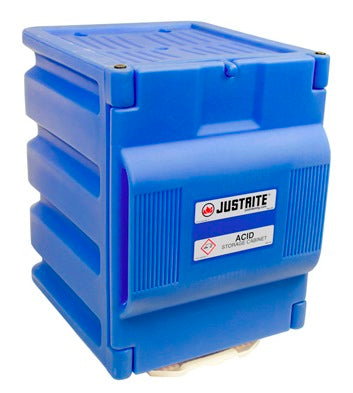
15 Litre Polyethylene storage cabinet for Corrosive/Chemical Goods
1 Door, 1 Shelf
Capacity: 2 x 4 L Bottles
Weight: 14kg
Dimensions: 502H x 362W x 435D mm
Complies with Australian Standard AS 3780-2023 - The storage and handling of corrosive substances
For highly corrosive acids such as Phenol, Nitric Acid and Sulphuric Acid. Justrite's polyethylene cabinets offer the most resistance to chemical corrosion and leaks. Clearly labelled for ACID contents and accept a padlock (not included) for added security.
Safely store up to two 4-litre bottles of acids or bases in this durable, compact cabinet. Never worry about corrosion completely metal free polyethylene design offers excellent chemical resistance against spills or damaging vapors.
Includes two polyethylene spill trays, use one for inside the cabinet to contain leaks and remove for easy cleaning. Store the extra tray under the cabinet, and remove for use as a handy work top. Hinge door from either side for best worktop utilization accepts a padlock (not included) for security.
Three application specific labels identify contents to safety store and segregate incompatible chemicals - ACID, BASE, and CORROSIVE.
Research environments using many different types of chemicals have special storage requirements. Whether using acids, bases or solvents, it is critical that incompatible liquids are segregated to avoid disastrous explosions or fire.
The SDS (Safety Data Sheet) should be reviewed to determine chemical characteristics and recommended storage practices.
All Justrite Cabinets are covered by a Ten-year limited warranty
*This item may require additional freight charges (to be confirmed after your order has been received)
FAQ's
Standards & Compliance
What Australian Standard applies to corrosive chemical storage cabinets, and is compliance mandatory?
The Australian Standard governing the storage and handling of corrosive substances is AS3780:2023 — The Storage and Handling of Corrosive Substances. This standard sets the minimum acceptable safety requirements for storage facilities, operating procedures, emergency planning, and fire protection for Class 8 Dangerous Goods — corrosive substances.
Compliance is effectively mandatory under Australian Work Health and Safety (WHS) Regulations. Employers who store hazardous chemicals classified as Class 8 Dangerous Goods are required to manage those risks — and AS3780 is the accepted compliance framework referenced by WHS regulators, fire authorities, and insurers across Australia. Many state and territory dangerous goods regulations also reference it directly.
The standard covers cabinet design and construction requirements, ventilation, spill containment, chemical segregation, signage and placarding, and emergency response provisions.
All Justrite corrosive chemical storage cabinets stocked by BIG Safety are manufactured to comply with AS3780:2023 and are independently fire tested and FM Approved by FM Laboratories.
What are Class 8 Dangerous Goods, and what makes a substance corrosive?
Under the Australian Dangerous Goods (ADG) Code — aligned with the United Nations Globally Harmonised System (GHS) — Class 8 Dangerous Goods are defined as corrosive substances: materials that cause damage or destruction to living tissue or other materials through direct chemical action upon contact.
Corrosive substances fall into two broad categories:
| Category |
pH Range |
Common Examples |
| Acids |
pH below 7 (typically below 2 for strong acids) |
Sulfuric acid, hydrochloric acid, nitric acid, phosphoric acid, chromic acid, battery acid, pool acid |
| Alkalis / Bases |
pH above 7 (typically above 11.5 for strong bases) |
Sodium hydroxide (caustic soda), potassium hydroxide, ammonium hydroxide, bleach (sodium hypochlorite) |
Corrosive substances are further classified into Packing Groups (PG) based on their severity:
-
PG I — High danger: causes full-thickness skin destruction within one hour of contact
-
PG II — Medium danger: causes full-thickness skin destruction within four hours of contact
-
PG III — Lower danger: does not cause full-thickness skin destruction but may cause corrosion to steel or aluminium surfaces
The packing group determines the storage quantity limits and the level of containment required in your cabinet and storage area.
When does my business legally require a corrosive goods storage cabinet under AS3780?
AS3780:2023 defines minor storage quantity limits below which reduced requirements apply. Once those limits are exceeded, storage in a compliant AS3780 cabinet is mandatory.
For Class 8 corrosive substances, the following cabinet capacity limits apply under AS3780: the maximum quantity in a single cabinet must not exceed 1,000 kg or L total, of which no more than 250 kg or L may be Packing Group II and no more than 50 kg or L may be Packing Group I.
For laboratory environments, indicative minor storage thresholds are up to 50 L per 50m² for all packing groups. For commercial and industrial environments, stricter limits apply — consult AS3780:2023 in full and your state dangerous goods regulator to confirm the thresholds for your specific occupancy type.
Even below the minor storage threshold, a dedicated AS3780-compliant cabinet is strongly recommended. Strong acids (pH below 2) and strong bases (pH above 11.5) are particularly hazardous and warrant dedicated cabinet storage regardless of quantity. Always consult AS3780:2023 and your state dangerous goods regulator to confirm the requirements for your site.
Do corrosive chemical cabinets need to be placarded, and what signage is required under AS3780?
Yes. AS3780 requires that all corrosive substance storage cabinets be clearly marked with the appropriate dangerous goods signage. The specific requirements are:
-
Class 8 Dangerous Goods label: each cabinet must display a Class 8 Corrosive Substances diamond label — a black-and-white diamond with the corrosion symbol (liquid dropping onto a hand and a metal surface). The label must have sides of at least 100mm in length and must be clearly visible when the cabinet doors are closed.
-
"CORROSIVE" warning identification: cabinets should be clearly identified as containing corrosive substances. All Justrite corrosive cabinets supplied by BIG Safety come with AS3780-compliant Class 8 placarding already fitted — no additional placard procurement is required.
-
Cabinet colour convention: while AS3780 does not mandate a specific colour, blue is the widely recognised industry convention for corrosive substance storage in Australia. Justrite corrosive cabinets are supplied in blue for instant visual identification on site.
-
SDS access: Safety Data Sheets for all stored substances must be readily accessible to workers and emergency responders at all times.
Cabinet Construction & Safety Features
Why are corrosive cabinets blue, and how are they different from yellow flammable cabinets?
Corrosive cabinets and flammable cabinets look similar from a distance but are engineered differently to address the distinct hazard profiles of Class 8 and Class 3 Dangerous Goods.
| Feature |
Corrosive Cabinet (Blue) |
Flammable Cabinet (Yellow) |
| Colour |
Blue — industry convention for Class 8 corrosives |
Yellow — established industry convention for Class 3 flammables |
| Standard |
AS3780:2023 |
AS1940:2017 |
| Primary hazard |
Chemical attack on tissue, materials, and cabinet structure from corrosive fumes and spills |
Fire and explosion from ignition of flammable vapours |
| Shelf design |
Metal base shelf + removable ribbed PE poly tray — prevents direct contact between corrosive containers and metal |
SpillSlope® steel shelves — angled to direct spills to the sump |
| Sump depth |
150mm deep — must hold at least 25% of maximum storage capacity |
150mm deep — must hold at least 25% of maximum storage capacity |
The two cabinet types must never be used interchangeably. Storing flammable liquids in a blue corrosive cabinet, or corrosive substances in a yellow flammable cabinet, compromises both the containment design and the fire protection characteristics of each cabinet type.
What construction features make a Justrite corrosive cabinet safe for acid and alkali storage?
Justrite corrosive cabinets are purpose-engineered to resist the chemical attack that makes Class 8 substances so hazardous to both workers and storage infrastructure. The key construction features are:
| Feature |
Specification |
Purpose |
| Double-wall steel construction |
1.2mm steel walls with 40mm insulating air gap |
Thermal barrier and structural rigidity — maintains integrity under fire exposure |
| Polyethylene (PE) poly trays |
Ribbed PE tray factory-fitted to each shelf with trough design directing spills to sump |
Isolates corrosive containers from metal shelf surface; prevents cross-contamination between shelf levels |
| 150mm deep liquid-tight sump |
Minimum 150mm depth; holds at least 25% of maximum cabinet storage capacity |
Captures and contains any spill or leak, preventing corrosive liquid from reaching the floor |
| Self-closing right-hand door |
Roof-mounted mechanism with adjustable closure rate; fusible link auto-closes at 74°C |
Keeps cabinet sealed to contain fumes; automatically closes in a fire event |
| 3-point fail-safe locking system |
Stainless steel bullet latches; distortion and bend-resistant locking bars |
Prevents tampering; ensures door remains fully sealed under thermal stress or physical impact |
| Full-length piano hinge |
Continuous full-length steel piano hinge on door |
Acts as a sealed barrier — prevents corrosive liquid or vapour escaping through the door gap |
| Adjustable levelling feet |
Four adjustable feet at each corner |
Ensures proper door alignment on uneven floors — critical for the door to seal correctly |
| Chemical-resistant powder coat |
Electrostatic powder coat, 88°C oven-baked |
Resists corrosive fume and splash attack; withstands twice the abrasive wear of standard finishes |
Why do corrosive cabinets have poly trays on the shelves, and can they be removed?
The ribbed polyethylene (PE) poly trays factory-fitted to each shelf in Justrite corrosive cabinets are a deliberate and critical design feature — they must not be removed during normal operation.
They serve two essential functions:
-
Chemical isolation: strong acids and caustic alkalis will chemically attack bare steel surfaces. Even small amounts of liquid contact from a container that weeps, drips, or has a contaminated exterior will progressively corrode a bare metal shelf, weakening it and eventually causing container failure or collapse. The PE poly tray creates a chemically resistant barrier between the containers and the steel shelf beneath.
-
Spill trough containment: the ribbed trough design of each poly tray directs any spilled liquid to the rear of the tray and then down into the cabinet sump — preventing cross-contamination between shelf levels. This is particularly important when both acids and bases are stored in the same cabinet, as mixing the two causes a potentially violent neutralisation reaction producing significant heat.
Additional poly trays and metal shelves are available separately from BIG Safety for all Justrite corrosive cabinet sizes. Keep at least one spare poly tray per shelf level on-site so a contaminated tray can be replaced immediately without downtime.
Important: never remove the poly trays to gain additional shelf height. This directly exposes the metal shelf to corrosive attack and defeats a key containment feature of the cabinet.
What Can Be Stored
What chemicals can be stored in a corrosive goods cabinet?
Corrosive goods cabinets are designed to store Class 8 Dangerous Goods — corrosive substances — as classified under the ADG Code and GHS. Common substances correctly stored in a Justrite corrosive cabinet at BIG Safety include:
| Type |
Examples |
Key Hazard |
| Strong mineral acids |
Sulfuric acid (H₂SO₄), hydrochloric acid (HCl), nitric acid (HNO₃), phosphoric acid (H₃PO₄), chromic acid |
Severe tissue burns; some produce toxic fumes |
| Pool and cleaning acids |
Pool acid (hydrochloric/muriatic), descalers, tile and grout cleaners containing acid |
Fume release; skin and eye burns |
| Strong alkalis / bases |
Sodium hydroxide (caustic soda/NaOH), potassium hydroxide (KOH), ammonium hydroxide |
Penetrating tissue burns; slow to show initial damage |
| Bleach and hypochlorites |
Sodium hypochlorite (bleach), calcium hypochlorite |
Corrosive; releases chlorine gas if mixed with acids |
| Other Class 8 substances |
Battery electrolyte (sulfuric acid), industrial degreasers, electroplating solutions |
Depends on substance — always check SDS |
Not suitable for storage in a corrosive cabinet: flammable liquids (use a yellow flammable cabinet — AS1940); oxidising agents (use a dedicated oxidiser cabinet); or pressurised gas cylinders (use a gas cylinder cage).
Can acids and alkalis (bases) be stored in the same corrosive cabinet?
This is the most critical compatibility question for corrosive storage, and the answer requires careful risk assessment.
Mixing acids and alkalis directly causes a neutralisation reaction that releases significant heat and can cause substances to boil, spit, and splash — dramatically worsening the exposure risk. Storing them in the same cabinet means a single container failure or spill could result in an immediate, violent reaction in the sump.
AS3780 and general dangerous goods segregation principles require that:
- Acids and bases that are highly reactive with each other should ideally be stored in separate dedicated cabinets
- If co-storage in the same cabinet cannot be avoided, acids and bases must be stored on different shelf levels — never on the same shelf — with the poly tray trough system preventing cross-contamination between levels
- Container integrity must be maintained — containers must be in excellent condition with no weeping, damaged lids, or deteriorating seals
- The SDS for each substance must be reviewed to confirm specific incompatibilities — some acid/base pairs react more violently than others
Best practice recommendation: use separate Justrite corrosive cabinets for acids and alkalis where volumes and site layout allow. Where a single cabinet must serve both, strict shelf separation and regular inspection of container condition are essential.
What chemicals must never be stored in a corrosive cabinet, and why?
Several chemical classes are strictly incompatible with Class 8 corrosive substances and must never be co-stored in the same cabinet. The consequences range from violent exothermic reactions to fire, explosion, and toxic gas release.
| Chemical Class |
Why Incompatible with Corrosives |
Correct Cabinet |
|
Class 3 — Flammable Liquids (petrol, solvents, alcohols) |
Many acids are oxidising and can ignite or accelerate combustion of flammable liquids. A combined sump spill creates severe fire and explosion risk. |
Yellow flammable cabinet (AS1940) |
|
Class 5.1 — Oxidising Agents (hydrogen peroxide, nitrates, permanganates) |
React violently with many acids and organic materials, releasing oxygen and intense heat. |
Dedicated oxidiser cabinet |
| Class 5.2 — Organic Peroxides |
Highly unstable; react dangerously with acids and heat-generating substances. |
Organic peroxide cabinet |
| Class 6.1 — Toxic Substances |
Reaction with corrosives can release additional toxic gases and create cross-contamination in a spill scenario. |
Toxic goods cabinet |
| Pressurised gas cylinders |
Corrosive fumes attack cylinder valves and connections; pressure vessel integrity is compromised in a spill. |
Gas cylinder cage |
All substances incompatible with Class 8 corrosives must be segregated by a minimum of 5 metres or stored in separate dangerous goods cabinets with independent spill containment systems.
Sizing & Selection
What size corrosive cabinet do I need, and what does BIG Safety stock?
Cabinet sizing should be based on the maximum stored volume of corrosive substances at any point, with headroom for operational peaks. The Justrite corrosive cabinet range at BIG Safety covers the following sizes:
| Cabinet |
Capacity |
Configuration |
Typical Use |
| 30 Litre |
30L |
1 door, 2 shelves |
Small laboratories, workshops, trade businesses with limited corrosive volumes |
| 60 Litre |
60L |
1 door, 2 shelves |
Automotive, cleaning contractors, pool chemical handling, light manufacturing |
| 160 Litre |
160L |
2 door, 3 shelves |
Mid-size industrial operations, schools, universities, commercial cleaning contractors |
| 250 Litre |
250L |
2 door, 3 shelves |
Medium-to-large industrial and manufacturing sites — stores up to 9 × 20L containers |
| 350 Litre |
350L |
2 door, 3 shelves |
Large industrial, mining, agricultural operations — stores up to 15 × 20L drums |
Practical sizing rule: size your cabinet to accommodate your peak stored volume at no more than 80% of rated capacity. This ensures the sump — required to hold at least 25% of maximum cabinet capacity under AS3780 — can contain a full container leak without overflow.
Also consider whether you need separate cabinets for acids and alkalis. If your site stores both, two smaller cabinets (e.g. 2 × 60L) may be more appropriate than one larger unit, providing proper segregation between acid and alkali storage.
Should I choose a metal Justrite corrosive cabinet or a polyethylene (poly) cabinet?
Both metal (powder-coated steel) and polyethylene (poly) corrosive cabinets are available at BIG Safety — the correct choice depends on the specific substances being stored and the site environment.
| Feature |
Justrite Metal Corrosive Cabinet |
Polystore Poly Cabinet |
| Shell material |
Double-wall powder-coated steel with PE poly trays on all shelves |
High-density polyethylene (HDPE) — fully non-metallic construction |
| Best for |
General Class 8 acid and alkali storage; FM Approved for mixed-hazard environments |
Highly concentrated or fuming acids where even coated metal may be attacked over time; oxidising corrosives |
| Fire resistance |
FM Approved fire tested — provides resistance in a fire event |
Not fire rated — suited to non-flammable corrosives only |
| Chemical resistance |
Excellent for most Class 8 substances via the poly tray barrier system |
Superior resistance for the most aggressive corrosives — no metallic components at risk of chemical attack |
| Warranty |
10 years |
10 years |
General guidance: for most Australian workplaces storing common acids (pool acid, descalers, battery acid) and alkalis (caustic soda, bleach), the Justrite metal cabinet with PE poly trays is the appropriate and most cost-effective solution. For sites storing highly aggressive fuming acids at high concentrations, a poly cabinet should be considered. Contact BIG Safety to discuss your specific substances and volumes.
Can I store corrosive chemicals and flammable liquids in the same cabinet if volumes are small?
No — never, regardless of volume. Corrosive substances (Class 8) and flammable liquids (Class 3) must never be stored in the same cabinet. This is a firm prohibition under AS3780 and dangerous goods segregation requirements, with no volume exemption.
The reason is fundamental chemistry: many strong acids are oxidising in nature and can catalyse or accelerate the ignition of flammable vapours. In the event of a spill or container failure inside a shared cabinet, the combined presence of corrosive liquid and flammable vapour creates conditions for fire, explosion, or violent chemical reaction — potentially simultaneously.
The cabinet colour coding system in Australia exists precisely to prevent this error:
-
Blue cabinet — Class 8 Corrosive Substances only
-
Yellow cabinet — Class 3 Flammable Liquids only
Where both corrosive and flammable substances are used at the same site, they must be stored in separate dedicated cabinets, separated by a minimum of 5 metres, or stored in separate dangerous goods stores with independent spill containment systems.
Placement & Maintenance
Where should a corrosive chemical cabinet be located within a workplace?
AS3780:2023 sets specific location requirements for corrosive substance storage within buildings. The key placement requirements are:
-
Ventilation: the storage location must be adequately ventilated to prevent the build-up of corrosive fumes or gases above workplace exposure standards. Natural or mechanical ventilation must be sufficient to keep vapour concentrations safe for workers.
-
Separation from incompatible substances: all substances incompatible with Class 8 corrosives must be segregated by at least 5 metres or stored in separate cabinets with independent spill containment. This includes flammable liquids, oxidising agents, and toxic substances.
-
Not in evacuation paths: the cabinet must not obstruct any emergency exit, fire door, or evacuation route — even partially.
-
Protected from temperature extremes and direct sunlight: corrosive substances must not be exposed to temperatures above their storage specification or to direct sunlight, which can cause pressure build-up in sealed containers.
-
Near emergency eyewash and shower equipment: AS3780 strongly recommends — and AS4775 effectively mandates — an emergency eyewash station within 10 seconds of travel from any area where corrosive substances are accessed or handled. For concentrated acids and strong caustics, the eyewash should be immediately adjacent to the hazard point.
-
Away from stormwater and sewer drains: the location should prevent spilled corrosive liquid from entering drainage systems, which creates significant environmental compliance obligations.
Is an emergency eyewash required near a corrosive chemical cabinet?
Yes — and this is one of the most critical co-requirements alongside corrosive chemical storage. AS3780 strongly recommends — and AS4775 (Emergency Eyewash and Shower Equipment) effectively mandates — the availability of emergency eyewash equipment within 10 seconds of travel from any area where corrosive substances are accessed or handled.
For environments handling concentrated acids or caustic substances:
- A plumbed eyewash station (or a portable self-contained unit where plumbing is unavailable) must be within 10 seconds of unobstructed travel — typically within 10 metres of the hazard point
- Where whole-body exposure is possible — for example, when dispensing or decanting from large containers — an emergency safety shower is also required within the same 10-second travel distance
- For the most dangerous concentrated acids and caustics, AS4775 recommends positioning the eyewash immediately adjacent to the hazard point — not merely within 10 seconds of travel
BIG Safety is Australia's emergency shower and eyewash specialist. The full range of Speakman plumbed eyewash stations, combination shower and eyewash units, and portable self-contained eyewash stations is available at bigsafety.com.au — allowing you to meet your AS4775 obligations alongside your AS3780 cabinet requirements from the one supplier.
How should a corrosive chemical cabinet be maintained and inspected?
Corrosive cabinets require more frequent inspection than flammable cabinets because the stored substances actively attack materials — including the cabinet itself if containment is compromised. The recommended maintenance schedule is:
Daily:
- Ensure the cabinet door is fully closed and latched after every access
- Visually check for evidence of leaking containers — discolouration, crystalline deposits, or liquid in the poly tray troughs are warning signs requiring immediate action
Weekly:
- Inspect the poly trays on each shelf — remove any accumulated liquid or residue and clean with water. Replace any tray that is cracked, discoloured, or structurally compromised.
- Check the sump — remove any accumulated corrosive liquid using appropriate PPE (chemical-resistant gloves, eye protection, and apron) and dispose of it in accordance with your SDS and local environmental regulations
- Confirm the self-closing door mechanism operates correctly — the door should close fully and latch without manual assistance
Monthly / Quarterly:
- Inspect all container labels, lids, and caps — replace any container showing signs of chemical attack, weeping, or damaged seals
- Inspect the cabinet shell, floor, and door edges for signs of corrosive attack — pitting, rust, or coating breakdown reaching bare metal requires immediate remediation
- Check the levelling feet — confirm the cabinet remains level so the door seals correctly
- Verify placarding and warning labels remain legible and undamaged
Annual:
- Conduct a full formal inspection with a documented maintenance record
- Replace the fusible link in the self-close mechanism if it has been exposed to heat or corrosive fumes
- Review all stored substances against the SDS register — dispose of any expired, unlabelled, or unnecessary stock through a licensed chemical waste contractor
All Justrite cabinets carry a 10-year limited warranty. Spare poly trays and additional metal shelves are available separately from BIG Safety for all Justrite corrosive cabinet sizes.